
Microwave technology plays a critical role in fields such as communications, physics, and medicine. Currently, components like microwave antennas and detectors are evolving toward miniaturization, integration, and intelligence. However, traditional microwave detection systems typically consist of discrete components such as antennas, filters, amplifiers, and rectifier circuits, which result in a relatively large overall footprint. Their size and power consumption constraints on further system integration and application expansion.
Recently, the Nano Fabrication Facility at the Suzhou Institute of Nano-Tech and Nano-Bionics (SINANO) of the Chinese Academy of Sciences, in collaboration with partner teams, has made significant progress in the research of on-chip integrated microwave devices. For the first time, they successfully achieved monolithic integration of a MEMS magnetoelectric antenna with a nanoscale spin-torque diode. The related research findings were published online in Nature Nanotechnology under the title "A CMOS-compatible, scalable and compact magnetoelectric spin-torque microwave detector." (https://www.nature.com/articles/s41565-026-02129-w)
The research team innovatively proposed a monolithic integration strategy combining magnetoelectric materials with spintronic materials. By exploiting magnetoelectric coupling effects to fabricate a miniaturized magnetoelectric antenna and leveraged electron spin properties to achieve highly sensitive microwave detection. Through magnetron sputtering and chemical mechanical polishing processes, atomic-level precision and seamless monolithic integration of multiple materials were realized. By further integrating micro-nano fabrication and MEMS processing technologies, an on-chip integrated device compatible with CMOS processes was developed. With a total area occupation of less than 0.4 mm², this device enables highly sensitive wireless detection of microwave signals, achieving a detection sensitivity exceeding 90 kV/W and a noise-equivalent power as low as approximately 3 pW/√Hz.
This research builds upon the team's earlier achievements (Nat. Commun. 7, 11259, 2016; Phys. Rev. Appl. 11, 014022, 2019; Appl. Phys. Lett. 121, 203504, 2022; Nat. Commun. 14, 2183, 2023). Notably, the integration technology demonstrates excellent scalability. The research team successfully fabricated a scalable on-chip microwave detection array, further enhancing its sensitivity to 446 kV/W, laying a solid foundation for subsequent technology transfer and applications.
This study represents a significant milestone in monolithic integration technology, providing crucial support for the development of high-sensitivity, scalable next-generation miniaturized microwave detectors. Prof. FANG Bin, Giovanni Finocchio, ZENG Zhongming are corresponding authors. The research also benefited from the guidance and support of experts such as Professor ZHANG Xixiang from King Abdullah University of Science and Technology (KAUST), Saudi Arabia, Professor CHEN Aitian from the University of Electronic Science and Technology of China, and Associate Professor ZHANG Like from Wuxi University. This work was supported by projects including the National Natural Science Foundation of China, the Young Scientists Program of the Key Research and Development Plan, the Frontier Project of Jiangsu Province, the Pioneer Initiative Talent Recruitment Program of the Chinese Academy of Sciences, and the Suzhou Gusu Leading Talent Program.
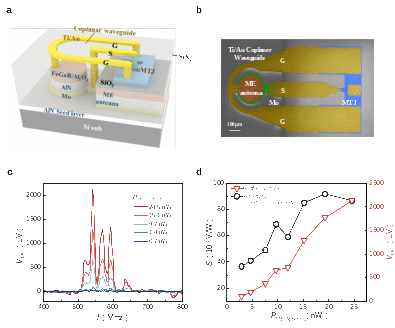
Schematics of the integrated microwave detector and device’s detection performance.
downloadFile